Most organisations don’t set out to deliver a poor customer experience. In fact, many invest heavily in tools, processes, and metrics designed to do the opposite.
And yet, small moments still go wrong.
Not the dramatic kind that trigger complaints or refunds, but the quieter ones that leave people slightly dissatisfied. They are often the result of sensible decisions made in isolation, which only reveal their downsides when they meet a real person.
The three experiences below are unrelated on the surface. Taken together, they say something useful about how organisations present themselves to the people they serve.
A birthday lunch and a missing conversation
My wife booked a table at a pub she likes for a birthday lunch. Her first call went unanswered. On the second attempt, she got through and asked for a dog-friendly table, ideally close to the fire.
I called separately to ask whether anything could be done to mark the birthday. Nothing elaborate. Perhaps a candle on a brownie or a simple dessert. I was told that wasn’t possible, but that I was welcome to bring in my own cake.
When we arrived, we did have a dog-friendly table, but not one near the fire. That part of the message hadn’t been passed on. The staff on the floor picked up on our disappointment immediately and worked hard to put things right.
Then, when I mentioned the birthday, they suggested exactly what I’d asked for on the phone.
Later, we discovered why. The initial call hadn’t gone to the pub at all. It had gone to an outsourced “base camp”, and not everything had made it through.
No one on site had done anything wrong. The staff were excellent, and we enjoyed the lunch. But a decision taken to drive efficiency elsewhere had created friction at the point where it mattered most. From our point of view, there had been one conversation. Internally, there had been several.
The join showed.
When internal distinctions meet external reality
I recently spoke with some IT leaders about an organisation that was trying to improve its Net Promoter Score. Unfortunately, there were some inconsistencies in delivery, particularly around project work.
Internally, this prompted a familiar discussion. What counted as “service”? What sat outside it? Which activities should influence customer feedback, and which should not?
From the customer’s point of view, those distinctions barely existed.
They saw one supplier and one relationship. Projects and service were not separate experiences; they were simply different parts of the same one. Until everything worked consistently, the feedback reflected that inconsistency.
These internal distinctions are not unreasonable. They matter for governance, accountability, and commercial clarity. But customers don’t experience suppliers through operating models. They experience outcomes, and they judge the whole by the weakest part.
Once again, the organisation was presenting its internal structure to the outside world.
“Oliver”, broken data, and silence
The third example is smaller, but less forgivable.
I received a marketing email from a company offering to help me get better outcomes from my data analytics. It was addressed to “Oliver”. My name, is “Mark”.
I ignored it. They followed up. Still “Oliver”.
I replied, deliberately using the wrong name in return, and explained that I didn’t need their services. I also pointed out that there was no unsubscribe option on their email.
I never heard back.
I wasn’t a customer, and I wasn’t complaining. I was responding to an approach and giving clear feedback on why it wasn’t landing. Whether the issue was bad data, a broken CRM, or careless automation is almost beside the point.
The attempt to engage was sloppy, and the silence that followed suggested nobody was listening anyway.
What these moments have in common
These stories aren’t really about pubs, IT services, or marketing emails. They’re about how organisations choose to present themselves.
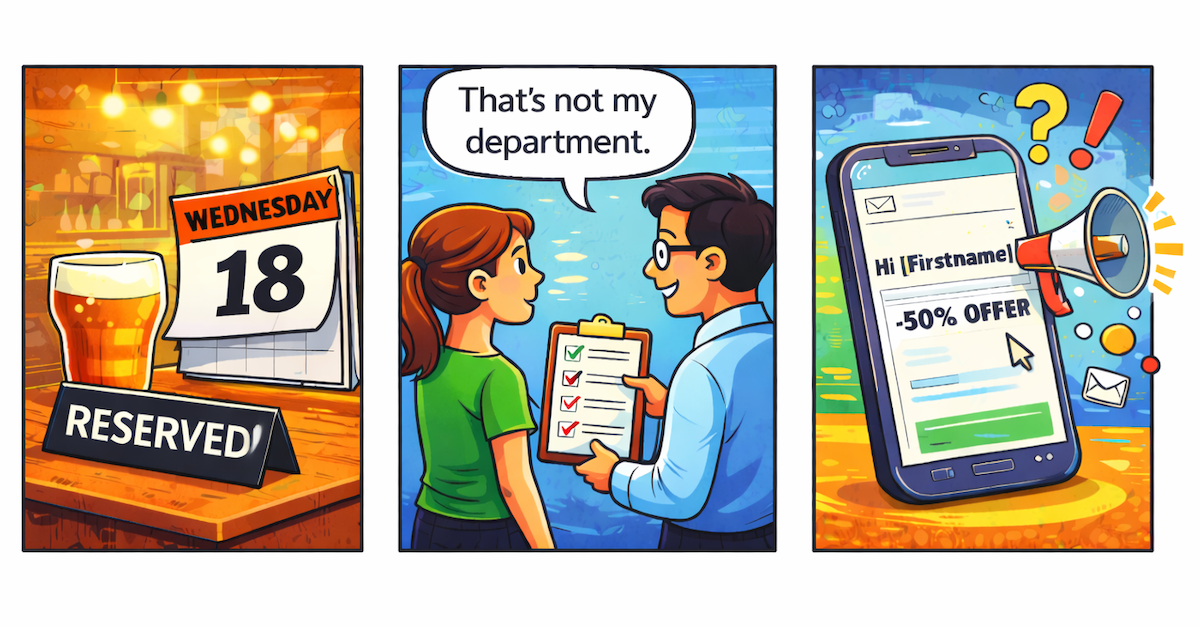
In one case, efficiency gains elsewhere fractured the experience at the frontline. In another, internal structures were allowed to leak into the customer relationship. In the third, a poorly executed attempt to win new business did more harm than good.
Different contexts, but the same underlying problem.
Customers experience organisations horizontally. Most organisations are still designed vertically. When responsibility, information, or ownership changes hands internally, customers feel it immediately.
People don’t move through departments. They move through moments.
Presentation matters more than intent
At least one of these organisations was careless. The others were well-intentioned but exposed by the way they had chosen to operate.
The outcome, however, was the same.
Each of them presented itself poorly at a moment that mattered, whether through broken handovers, visible internal boundaries, or a lack of basic care in how someone was approached.
Customers and prospects don’t see effort charts or efficiency targets. They see what lands in front of them and draw conclusions from that alone.
And those conclusions, once formed, are difficult to undo.