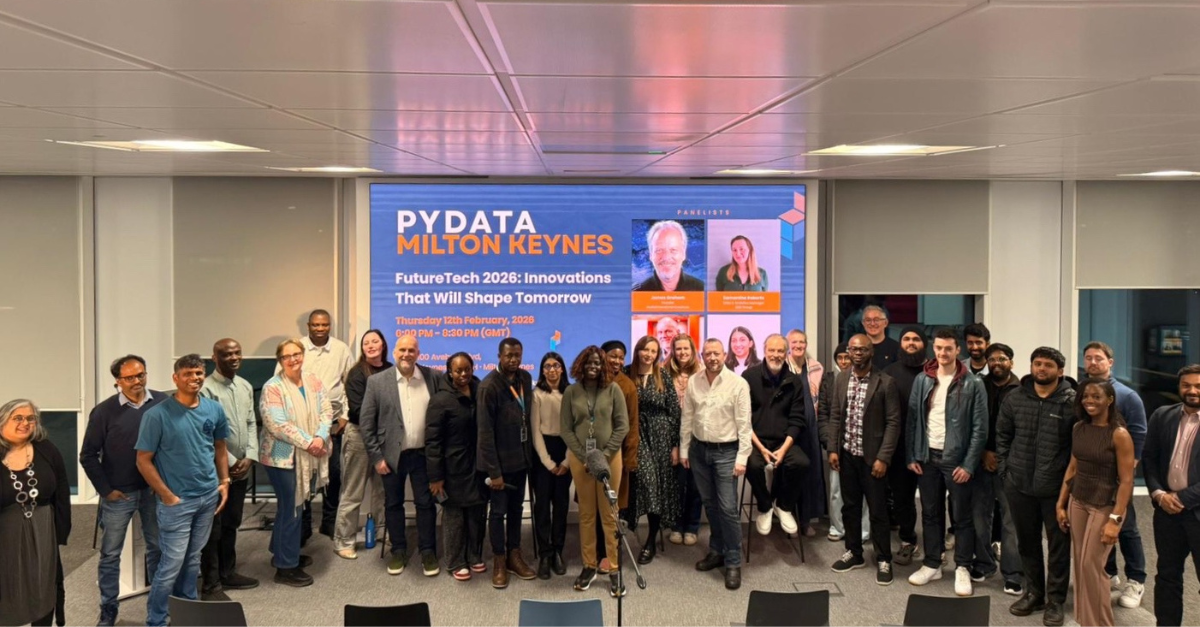
A few weeks ago I joined a panel at the PyData Milton Keynes meetup.
PyData is a global community of developers, data scientists and engineers working with open-source data tools. The Milton Keynes chapter only began running events in 2025, and this was its first in-person gathering.
The panel was hosted by Grace Farayola. I was joined by Samantha Roberts from SDG Group, Madara Premawardhana from the University of Buckingham, and James Graham, former CEO of BsoftB.
The evening’s theme was FutureTech 2026: innovations that will shape tomorrow.
Ahead of the event Grace shared a set of questions that she intended to ask the panel. The discussion covered a lot of ground, but I’d prepared a few thoughts in advance.
Sadly, I don’t have a record of the great insights that my fellow panellists shared (it’s pretty hard to take notes when you’re on the panel). Instead, this is a short reflection on the topics I was asked to cover, based on the answers I prepared beforehand.
The future of tech is not just about “the shiny stuff”
When asked what the future of technology means from my perspective, my answer was fairly simple.
The future of tech is outcome-led: secure platforms, trusted data and modern applications solving real problems, with AI built in so value can be delivered safely and at scale.
It’s not particularly glamorous.
There are plenty of exciting innovations and bold ideas in the industry right now. But most organisations are still trying to get the fundamentals right while staying responsive to their customers, clients or citizens.
That may not make headlines, but it’s where progress really happens.
AI is becoming a core operating layer
The more interesting question is what organisations should prioritise in 2026.
The answer isn’t “more technology”. It’s the technology that turns AI into measurable outcomes.
AI has moved beyond experimentation. It is becoming part of the operating fabric of organisations: a productivity multiplier, a margin lever and a differentiator for customer experience.
That puts CTOs firmly in the hot seat.
Technology leaders are increasingly expected to turn AI into real business impact, not innovation theatre.
The foundations that make this possible are not new:
- Trusted, unified data.
- Modern, composable platforms.
- Secure and resilient infrastructure.
- Experience-led technology that people actually adopt.
- Sustainable architectural choices.
- Cross-functional teams that can deliver outcomes.
Put simply: AI only works when the foundations are solid.
Turning experiments into outcomes
Many organisations are still experimenting with AI and cloud technologies.
The challenge is moving from experiments to measurable value. The simplest way to do that is to start with the outcome: what does good look like? (Remember Stephen Covey’s “Seven Habits of Highly Effective People”, where the second habit is “begin with the end in mind”.) In other words, decide which metric you want to change, then work backwards.
A practical playbook looks something like this:
- Start with the outcome – which metric will move?
- Prepare the data – quality, lineage and access.
- Prepare the platform – APIs, automation and observability.
- Put guardrails in place – security, governance and responsible AI.
- Deliver a thin slice – prove the value quickly.
- Scale what works.
It’s often said that a very high percentage of AI projects fail (usually quoting various analysts and academic institutions). It’s not just AI projects either. Many initiatives struggle because they start with the technology rather than the outcome.
If you can’t explain the impact in a sentence, the project probably needs more thinking.
Innovation and compliance are not opposites
One of the debates during the panel was whether organisations can realistically be both innovative and compliant.
I think they can.
Innovation and compliance are often presented as competing priorities (“while America innovates, Europe regulates”), but that’s the wrong way to think about it.
It’s more like driving a car. The brakes and steering don’t slow you down. They allow you to move faster, safely.
Technology governance works the same way. When guardrails are built into the design from the start, they enable innovation rather than restrict it.
The real shift for technology leaders
The biggest change we are seeing is not technical. It’s organisational.
AI outcomes are becoming career-critical for technology leaders.
In many organisations, AI is no longer a side experiment. It is becoming a core part of how the business operates, influencing productivity, margins and customer experience.
That means the expectations placed on technology leaders are changing.
Just as CFOs are held accountable for financial performance, CTOs will increasingly be judged on whether AI initiatives move the business forward.
Not demos. Not pilots. Not slideware. Real business outcomes.