Back in October 2025 I spent three days at Microsoft’s SME&C EMEA Sales and Partner Summit in Dublin. More than 3000 people were there — a mix of Microsoft staff and partners working across the Small, Medium Enterprise and Channel (SME&C) sector.
At the time I wasn’t entirely sure how much I was supposed to be sharing publicly, and I certainly didn’t get the chance to download any slides. Since then, Microsoft’s Ignite conference, Microsoft AI Tour, and a steady stream of other announcements have brought much of that thinking into the public domain.
One phrase I heard repeatedly during the event was clearly designed to stick in the mind:
“Frontier firm.”
It’s one of those terms that feels destined to appear in slide decks and conference presentations for the next few years. But behind the branding there is an interesting idea about how organisations might evolve as AI becomes embedded in everyday work.
Where the term comes from
The phrase didn’t originate at the summit. Microsoft introduced it earlier in its 2025 Work Trend Index report, which was titled “The Year the Frontier Firm Is Born”.
The idea is that organisations are moving towards a new operating model built around hybrid human-AI teams, where people increasingly direct AI assistants and agents to complete work.
In a blog post titled “Becoming a Frontier Firm: Unlocking the business value of AI”, Microsoft described the concept like this:
“A Frontier Firm is defined not by its size or industry, but by its mindset and execution. These organizations lead with AI-first differentiation, embedding intelligence across every layer of the business — from employee experiences to customer engagements to core processes. ‘Becoming Frontier’ means moving beyond experimentation to enterprise-scale transformation…”
In other words, it’s less about a particular technology and more about how organisations operate when AI becomes part of the normal flow of work.
AI as the defining technology of our time
The summit’s opening keynote set the tone clearly. AI, we were told, is the defining technology of our time.
That may sound like the usual technology conference rhetoric, but I think most people will agree that the scale of investment and innovation is staggering. Something significant is happening.
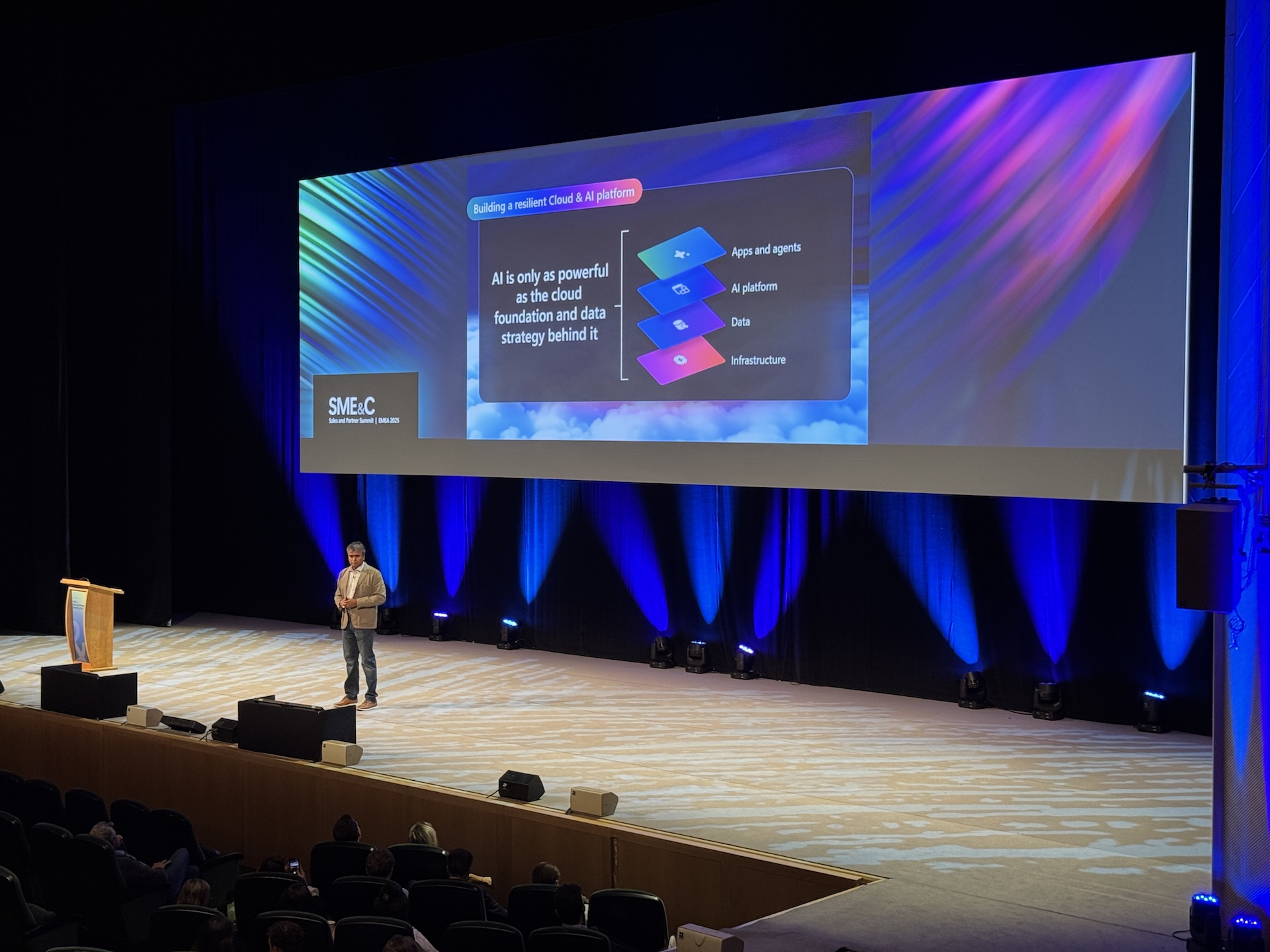
One message that comes through repeatedly is that AI is only as good as the data and the platform behind it. That’s not unique to Microsoft. It’s a point we hear across the industry, and it’s probably one of the biggest barriers to meaningful AI adoption. Many organisations are discovering that their data is fragmented, poorly governed, or simply not ready to support large-scale AI use.
Another challenge is choosing the right starting point. Successful AI projects tend to begin with a clearly defined business problem — something that can be measured and improved — rather than with the technology itself.
Unsurprisingly, Microsoft’s framing focuses heavily on the platform and the tools. After all, that’s what Microsoft sells.
But the underlying message still holds: without strong foundations in data, platforms, and clear use cases, AI initiatives rarely move beyond experimentation.
The path to becoming a Frontier Firm
At the summit, Microsoft described the journey toward a Frontier Firm as a progression — from humans with assistants, to human-agent teams, and ultimately to human-led, agent-operated organisations.
| Stage | Description |
|---|---|
| Human with assistant | Employees use AI assistants embedded in everyday tools. Copilot (other AI assistants are available) helps draft documents, summarise meetings, analyse information and automate routine tasks. Humans remain firmly in control. |
| Human-agent teams | Specialised AI agents begin handling parts of workflows. Humans still provide direction and oversight, but agents gather information, analyse data and trigger actions across systems. |
| Human-led, agent-operated | Humans set strategy and intent while AI agents execute much of the operational work needed to deliver outcomes. |
Whether organisations will actually operate this way remains to be seen. But it’s a useful way of describing the direction Microsoft believes AI-powered organisations are heading.
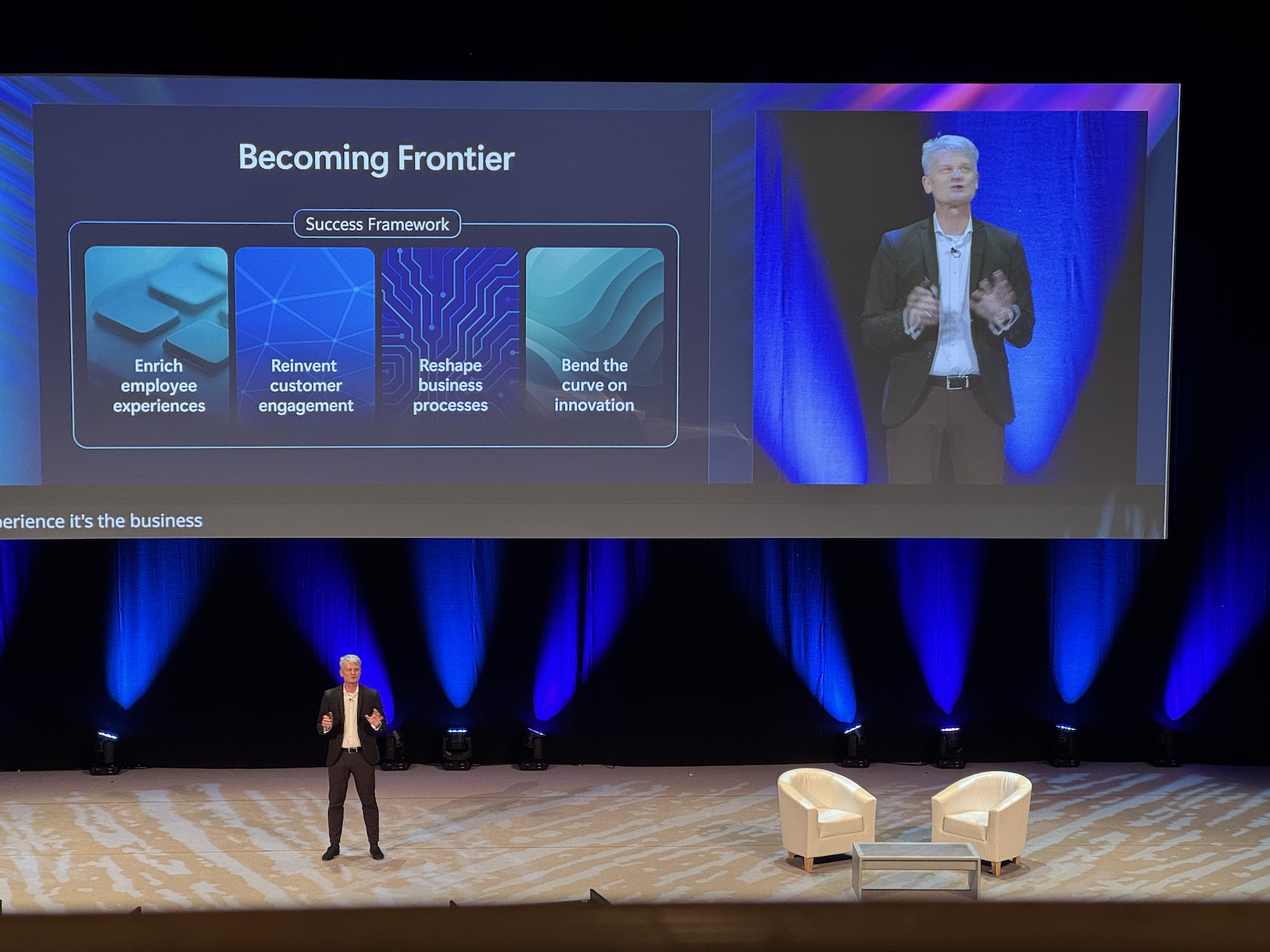
Microsoft also outlined a success framework for organisations becoming Frontier Firms. Rather than focusing purely on technology, the framework highlights four areas where AI is expected to reshape how organisations operate:
- Enrich employee experiences
- Reinvent customer engagement
- Reshape business processes
- Bend the curve on innovation
These themes reflect where Microsoft sees AI having the greatest impact across organisations — not just in productivity tools, but in how businesses interact with customers, design processes, and innovate.
Data foundations
We’ve already established that good data is essential for successful AI adoption, so it’s no surprise that this is one of the areas Microsoft spent a lot of time talking about.
The problem is easy to understand. Most organisations didn’t design their data environments for AI. Systems have grown organically over many years, often across multiple platforms, acquisitions, and generations of technology. Data ends up scattered across applications, databases, file stores, and analytics tools — often with inconsistent governance and visibility.
Microsoft’s answer to that challenge centres on Microsoft Fabric. Fabric is the platform designed to bring together analytics, engineering, integration and governance capabilities in a single environment.
Underneath Fabric sits OneLake — a SaaS-based data lake intended to act as a single, unified data store for the organisation.
The goal is to reduce fragmentation and make data accessible across analytics, applications and AI workloads. In Microsoft’s view, that kind of unified data estate is what allows organisations to move from isolated AI experiments toward something that can operate at scale.
The platform underneath the AI story
Behind all the talk of AI sits something more familiar: the cloud platform.
Microsoft currently describes its portfolio in three broad areas — AI business solutions, cloud and AI platforms, and security — built on what it calls a trusted and secure foundation.
Microsoft Azure has matured significantly since the early days of Windows Azure more than fifteen years ago. Today it provides the infrastructure, development platforms, data services and AI capabilities that underpin much of Microsoft’s technology stack.
Developers also play a central role in this story. Tools like Visual Studio and GitHub sit at the heart of how organisations build applications, integrate systems and increasingly create AI-powered solutions.
In other words, while the conversation may focus on Copilot and agents, the underlying platform — cloud, data and developer tooling — is what makes those capabilities possible.
Trust becomes critical
If AI systems are going to operate across business processes, trust becomes even more important.
AI can surface information that previously sat quietly in documents, emails and collaboration platforms. That creates new challenges around governance, security and compliance.
Identity, data protection and threat detection therefore move from the background to the centre of the conversation.
Security is no longer something that sits alongside AI. It becomes part of the foundation that makes AI possible.
Microsoft’s answer to that challenge sits in its broader security and identity platform — services like Entra for identity, Purview for data governance and compliance, and Defender and Sentinel for threat protection and monitoring — alongside endpoint management through Intune.
From experimentation to transformation
The shift Microsoft is describing with the idea of a Frontier Firm isn’t about a single product or capability. It’s about how organisations operate when AI becomes part of everyday work.
That means embedding AI into real business processes, supported by strong foundations in data, cloud platforms and security.
So what exactly is a Frontier Firm?
In simple terms, a Frontier Firm is Microsoft’s way of describing organisations that embed AI deeply into how they operate.
Employees work alongside AI assistants. Agents begin to handle parts of workflows. Human judgement focuses more on direction and decision-making, while systems take on more of the operational work.
Whether the phrase itself will stand the test of time is another question. Technology marketing has a habit of introducing new labels every few years.
But the underlying idea is straightforward enough: organisations using AI not just as a tool, but as part of how work gets done.