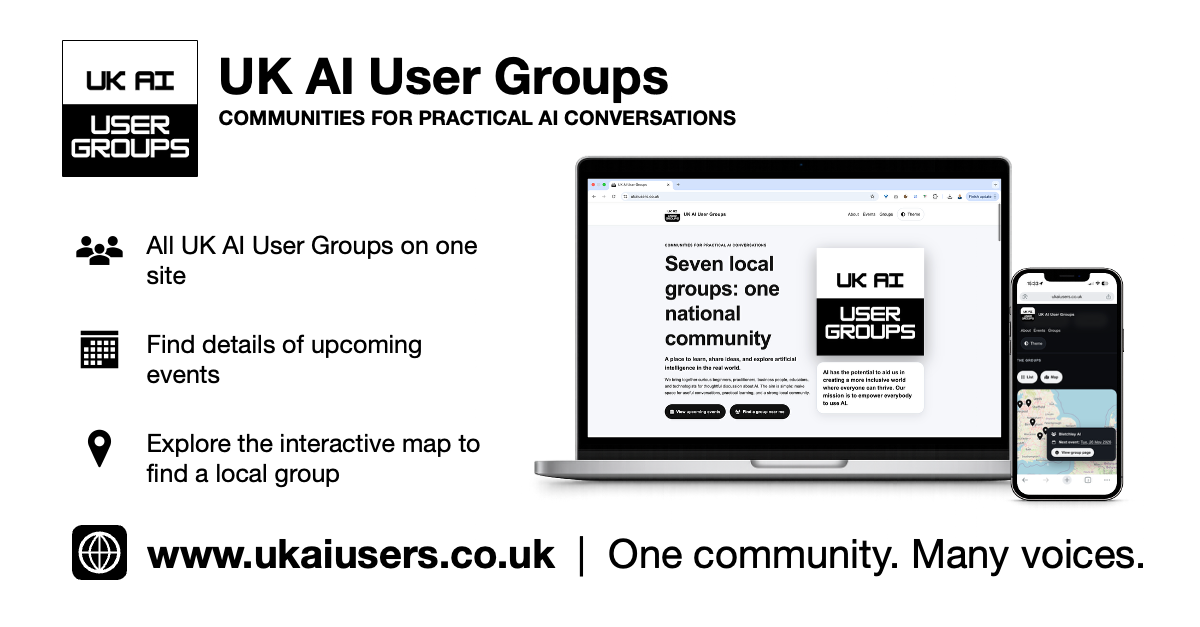
From Bletchley to a nationwide AI community — and a vibe-coded website
I’m pretty stoked today because, after a very late night vibe coding session last night, I finally got the UK AI User Groups website to a state where I felt it was ready to go live. And, now the DNS changes have propagated, we are in business.
I’ve been involved in the Bletchley AI User Group from the sidelines for a while, but then my friend Phil Kermeen got involved and I became a regular attendee. After I was invited to speak last year, I suddenly found myself “voluntold” onto the committee.
With strict instructions from my family not to take on yet more projects/responsibilities, I agreed to photograph the Bletchley events and create a website.
That escalated quickly.
I am not a web developer
OK, so, I’m not a web developer. I have a Computer Studies degree (so technically, “I can code”), but I haven’t written a line of code professionally since my internship in 1992/3 — except perhaps some MS-DOS batch files or a bit of bad PowerShell. I’ve had my own website since at least 1998 though, so dabbled in HTML/CSS, but mostly used WordPress (until I switched to Hugo earlier this year — that’s another story/post).
The point about the UK AI User Groups site is that I wanted to write something that:
a. is easy to maintain; b. separates presentation from site logic and from data; c. looks OK, using the group’s visual identity (I’m not a designer either); d. feels “modern”; e. is accessible and easy to navigate.
Cutting code
And this is where the vibe coding comes in…
I know some people will tell me there are better tools for coding, but I have a personal ChatGPT Plus subscription. That was enough for me to create a simple single-page site using HTML, CSS, and JavaScript. And then I got the memo that this was not just for Bletchley AI, but for all of the UK AI User Groups, adding a extra page for each group.
I used the W3.CSS framework with Font Awesome icons — in common with my own websites — and ChatGPT handled much of the app logic and presentation. Data (events) are read from a single file, and presented in various forms across the site.
There’s light and dark modes, and the site is responsive so it should gracefully adjust to different devices — though the best user experience is still in a desktop browser. I have my limitations (testing/access to devices and skill — as well as time).
A companion script pulls images from the actual event management platforms (currently Meetup and Luma) so we can bring the event cards on the site to life. And then, on the train home last night I decided to see if I could show the various groups as either a list or on a map — so Leaflet does all the heavy lifting for the maps, with the page offering a toggle between the two views.
Hosting it for free
Oh yes, and did I say this is free? Yep, hosted in a GitHub repository with CI/CD to push it to Azure Static Web Apps on the free tier.
The last challenge was the DNS setup for the custom domain — not difficult, but one of those tasks where everything feels slightly more complicated than it should because of the quirks of the GoDaddy domain registration.
So that’s it. It went live today. A vibe-coded website at https://www.ukaiusers.co.uk/
“Anyone can do that”
Now, some will be reading and saying “whoop-de-do Mark, anyone can do that” — and that’s my point. I’m not taking a professional developer’s work away — proper sites still need proper skills. Not just to write code but to perform proper analysis, design, creation, testing, and support. The code was never the whole job.
What generative AI (and just enough skill to be dangerous) has allowed me to do is create something functional, for a group with no budget for professional services (any sponsorship revenue goes to running the events). And it’s allowed me to exercise my inner geek.
And that’s where I see value in generative AI. Bouncing ideas around. Helping to draft content. Assisting people. And letting projects that would never get past the business case come to life.
The support question
Let’s discuss the elephant in the room though — support. A vibe-coded site is a bit of a black box. I understand enough to say “this is what I have created and this is how it works at a high level”. I don’t understand every line of JavaScript though, and the CSS had a lot of fixes applied to get it to behave properly.
I’ve no doubt that this could do with a complete refactor. Maybe I can use another AI assistant for that some time.
And that’s the main point I want to get across. Vibe coding is not magic. It doesn’t remove the need for skill, judgement or support. But it can lower the barrier enough for an idea to become real.
Sometimes that’s enough.
Especially when the alternative was another good idea sitting on the “maybe one day” pile.