Revisiting a 2017 CTO pitch — and connecting the dots with AI
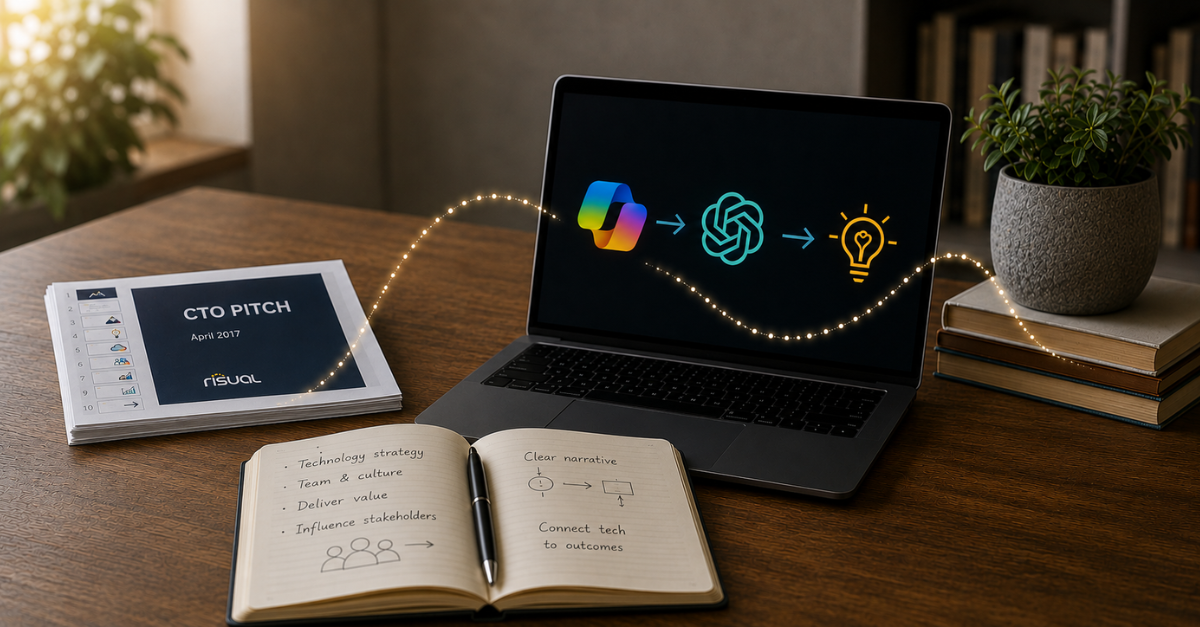
Recently, I asked Copilot to find a presentation I remembered creating in 2017.
It was a pitch to the directors at risual about why I should be their CTO. I hadn’t looked at it in years.
Going back to it now, with more experience and a different perspective, it’s easier to see what I was trying to articulate at the time — and where the gaps were.
Finding the past in a modern way
Copilot was able to locate the presentation quickly, searching across my OneDrive. That part felt straightforward and the more interesting part was what came next.
Rather than working directly with the file, I used Copilot to summarise the content. Then I took part of that transcript — with any sensitive details removed — and brought it into ChatGPT to help me think it through.
That might sound like an unnecessary extra step, but it was deliberate. I wanted to stay within the right security boundaries, and I’ve also found that I prefer using ChatGPT* as a writing assistant when I’m shaping ideas into something more structured.
Using AI to make sense of ideas
From there, the process became less about retrieval and more about interpretation.
The presentation itself hadn’t changed, but the way I could talk about it had. With the help of AI, it was easier to step back and see the narrative more clearly — what I was trying to argue, what I understood, and what I hadn’t yet worked out.
That included things that felt familiar from more recent conversations: the importance of influencing senior stakeholders, connecting technology to outcomes, and creating a clear narrative around what an organisation does and why it matters.
Those ideas were present in 2017 but they weren’t fully formed.
Connecting the dots
By summarising, reframing, and reflecting the content back in different ways, it made it easier to identify a thread that runs through that original presentation and into the work I do today — including how I now describe my role. I was also pleased to see the alignment with my current job description (which is fortunate!).
And that process ultimately led to two posts I’ve written recently — one about what a CTO does, and another about the path to vCTO.
A tool, not the answer
It would be easy to overstate the role of AI in all of this.
It didn’t create the ideas, and it didn’t replace the need for judgement. It helped surface and structure something that already existed. The final step was still mine — deciding what to keep, what to discard, and how to present it.
It’s an AI assistant, not an agent. And I do still constantly have to remind it how I write, and to drop its habits of writing broetry, reintroducing buzzwords, and forgetting the instructions I’ve given it for writing in my style.
Reflection
There’s something useful in revisiting old work with the benefit of time.
Not to prove consistency, or to show that the answers were always there, but to understand how ideas develop. Some of what we think early on is right. Some of it isn’t. Most of it sits somewhere in between, waiting for experience to catch up.
*I used to prefer ChatGPT. Since I got access to Copilot Cowork, it’s been transformational — but that’s another post.