OK, so there is a significant risk that this post will just be lost as noise in a sea of outcry and “analysis” of the recent Copilot charging changes, but here goes… this is my 4 penn’th.
First up, what’s this all about?
Microsoft has just taken Copilot Cowork from Frontier status — beta for those of us who remember when software was tested before being released to an unsuspecting public — to general availability (GA). And now the meter is running, with charges taking effect from 1 July.
If you don’t use Copilot Cowork, then it’s off by default. But if you used it in Frontier, then it will remain enabled and start accruing usage charges from 1 July. And that’s in addition to your base Microsoft 365 Copilot subscription.
An important caveat
Quoting one LinkedIn post:
“Your everyday Copilot has not changed. Word, Outlook, Teams, Chat. Still flat, per-user, predictable. […] The meter only runs when you send Cowork off to do multi-step work in the background.”
Why is this important?
Copilot Cowork has become a huge part of what I do. I previously found Microsoft 365 Copilot to be of limited use. It was OK, and had the advantage of being grounded in my business data, but the results were patchy. Copilot Cowork is built on Anthropic’s Claude models and, in my experience, the difference in output quality is night and day.
Since I got access in April, I have been delegating parts of my work to it — including daily analysis of my emails, messages and meetings, and helping me to draft content. At Node4, we even have skills that allow it to create content using the company brand.
How does the pricing work?
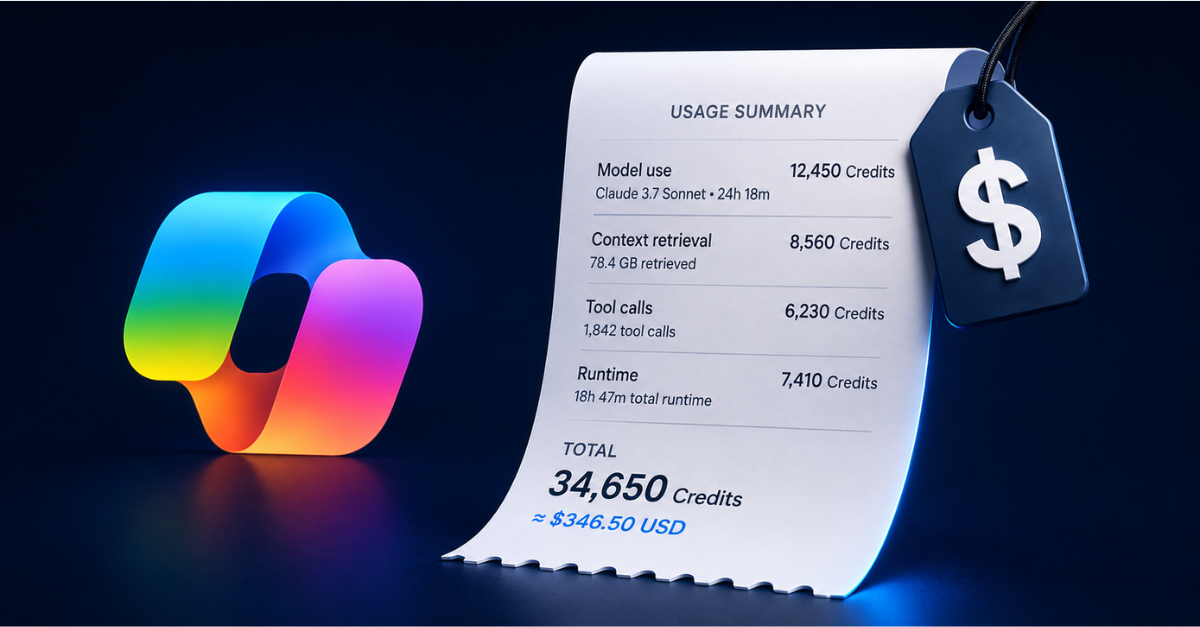
Each Copilot Cowork task is metered on four inputs and billed in Copilot Credits:
- Model use — which model runs, and for how long
- Context retrieval — how much of your data it reads
- Tool calls — how many actions it takes
- Runtime — how long the task runs end-to-end
A light task might be 125 credits (approximately $1.25), a medium task 500 credits (approximately $5), and a heavy task 2,500 credits (approximately $25).
Microsoft’s own model assumes 22-38 tasks per user per month. Spend is uncapped by default, and many tasks are scheduled — they run unattended with no-one watching the meter.
I used an estimation tool from Microsoft MVP Josh Cook to try and understand my costs. It was quite a lot — well into three figures for the last month — and I was away from work for two weeks!
[Edit: my colleague Jay Fitzhenry later told me about the /cost skill in Cowork, which provides details of credit usage in-session. These estimates were more reassuring (about half the cost), though I’m now confused about which number to believe. Regardless, it’s a consideration for all to consider.]
Now, we also have to consider that I have a cost as an employee. If Copilot Cowork saved time, then that may still have been a good investment. That’s a decision that needs to be made by my managers, though it would be good if I had the tools and insights to make informed choices about my use of AI tools. I have some latitude on other expenses that I incur for the company (e.g. travel), and there are some things I just cannot do (e.g. buy equipment). I’d like to think that we will reach a point where AI spend is similarly simple to justify or not.
A grace period
Microsoft has been extremely generous. It has to pay Anthropic for use of its models and we’ve all had free access during the Frontier phase. We’re still not paying, but the cost of running Copilot Cowork is suddenly visible.
I’d go further and say that the age of free or low-cost generative AI tool access is coming to an end. The financial (and environmental) costs are huge and the business model is still unclear.
Someone has to pay for all those GPUs eventually.
Using the right tools for the right jobs — and understanding which tasks will burn tokens
My analysis gave some other insights too. The analysis itself accounted for around 10% of my token usage. And some tasks that were particularly expensive were ultimately unsuccessful. I used the content from the chat, but the presentation slides it created were not up to scratch.
If I’d paid an agency to create something unusable, I’d be asking awkward questions about rebates. AI billing doesn’t work like that.
So, what can we do to avoid a huge bill?
It shouldn’t be a surprise that my employer, Node4, is all-in on AI. We have an extensive AI transformation plan in place and, like many organisations, we’re actively thinking about how to balance innovation with governance and cost control.
Without giving away specifics, uncontrolled Copilot Cowork usage could add significant costs to any organisation. Clearly that can’t be allowed — but there are some straightforward steps that can help.
| Control | Visibility | Efficiency |
|---|---|---|
| Set tenant, group and user spend limits | Configure usage alerts with named recipients | Choose appropriate plans once the run-rate is known |
| Apply hard caps so spend cannot run away | Review usage weekly by user, group and feature | Use cheaper models for routine work where appropriate |
| Keep Copilot Cowork scoped to approved groups | Enable per-task pricing visibility when available | Coach heavy users on cost-aware prompting |
| Apply per-user budgets inside group policies | Monitor scheduled and unattended tasks closely | Right-size who actually needs Copilot Cowork |
As Josh Cook says in his post, the takeaway is that:
- Prompt design matters.
- Context matters.
- Skills matter.
- Reusable instructions matter.
- Clear task boundaries matter.
If you hand Cowork vague work with no structure, you are going to burn more [tokens].
If you build skills, give clean context, and tighten the task, the experience becomes way more efficient
The grace period ends on 1 July 2026, so you need to act now.
None of this means Copilot Cowork isn’t valuable. Quite the opposite. The fact that we’re now having conversations about cost rather than capability really tells us something important about where these tools are heading.
Footnote: this post was written by a human who likes em dashes — I was too scared by the token cost to get an AI to do this for me, though I did use ChatGPT for the image.