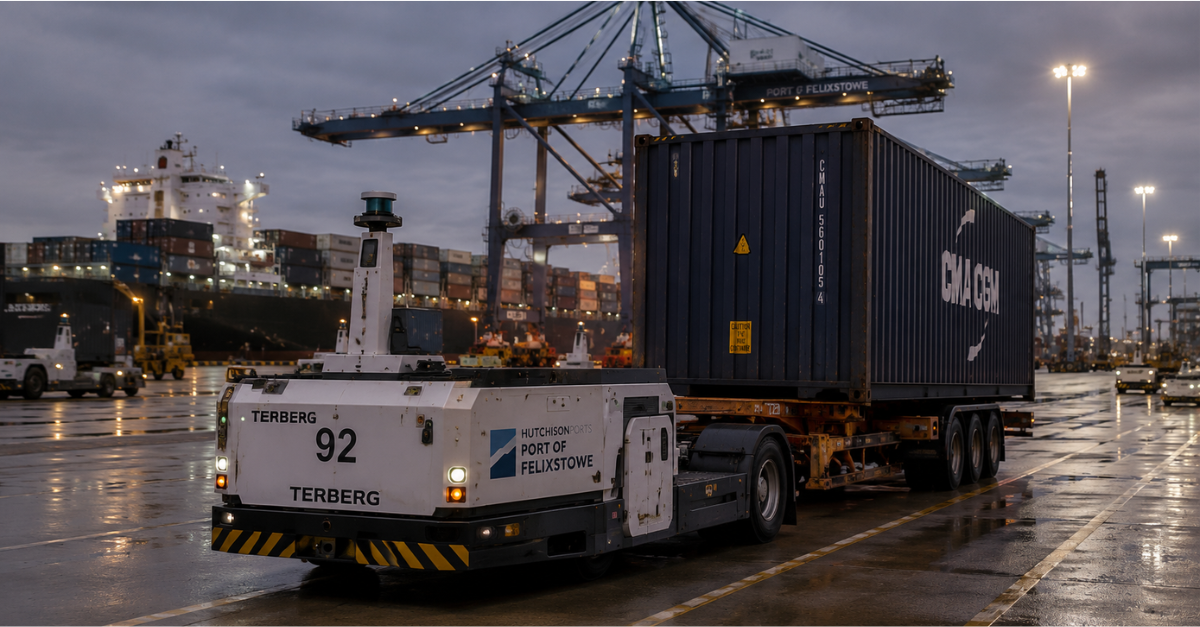
Earlier today, I shared a post on LinkedIn after reading about The Port of Felixstowe expanding its autonomous truck fleet to 100 vehicles.
I realised this isn’t really a story about ports. It’s a story about where autonomous driving delivers value first — and why that probably isn’t where most people are looking.
Last year I wrote about software meeting steel: the idea that AI is escaping our screens and beginning to interact with the physical world. From delivery robots and airport service robots to autonomous systems in warehouses and factories, we’re already surrounded by examples. They just don’t look like the self-driving cars we’ve been hearing about from billionaire (trillionaire) technology executives.
The expansion at Felixstowe is another step along the journey. This time, though, the robots aren’t delivering takeaway meals or moving pallets around a warehouse. They’re shifting shipping containers around one of Britain’s busiest ports.
And this isn’t a pilot or a proof of concept. It’s a fleet expansion. The technology has demonstrated enough value to justify significant further investment.
Looking in the wrong place
Normally, whenever autonomous vehicles are discussed, the conversation is centred around self-driving cars on public roads.
How will they cope with city traffic? Motorways? Country lanes? School runs? Snow? Roadworks? Cyclists? Pedestrians?
They’re fascinating problems, but I think we’re looking in the wrong place.
If you want to understand where autonomy will succeed first, don’t look at the public roads.
We already trust cars to drive themselves — sometimes
In truth, today’s cars already contain elements of autonomous driving.
Adaptive cruise control maintains a safe distance from the vehicle ahead. Lane centring gently steers the car. Automatic emergency braking can intervene if a collision appears imminent. Some systems will even change lanes or park the vehicle with minimal driver input.
These features are impressive, and they’re becoming increasingly commonplace. But they also reveal how difficult the remaining challenge is.
Anyone who has driven a modern car has probably experienced phantom braking, where the car reacts to a perceived hazard that isn’t really there. Equally, there are situations where the technology struggles to recognise something unusual because it doesn’t match the patterns it has been trained to detect.
A plastic bag blowing across the carriageway, a police officer directing traffic around an accident, or a child chasing a football into the road all demand judgement, not just object recognition.
Human drivers don’t just recognise cars, buses and lorries. We interpret context. We notice unusual behaviour. We anticipate what someone might do next.
That level of hazard perception remains extraordinarily difficult to replicate reliably across every possible road, weather condition and traffic scenario.
A port is a different world
Compare that with a controlled industrial environment, such as a port.
The roads are private. Routes are carefully defined. Speeds are low. Traffic flows are predictable. The vehicles all have a specific purpose.
That doesn’t make the engineering easy. It simply makes the problem more constrained. The unexpected still happens, but it happens within a much narrower set of possibilities.
More importantly, the commercial case is obvious.
Container shipping is built around efficiency. Every minute a ship spends alongside the quay costs money. Every unnecessary delay moving containers between cranes, storage yards and rail terminals affects the throughput of the entire port.
Autonomous vehicles don’t need to solve every edge case on Britain’s road network. They simply need to move containers safely, consistently and efficiently around a known environment.
If they can do that, they reduce bottlenecks, improve utilisation and generate a measurable return on investment.
We’ve seen this pattern before
Ports aren’t unique. Warehouse robots have been doing similar work for years. Delivery robots operate within carefully defined areas. Autonomous agricultural machinery works in fields with known boundaries. Mining companies have deployed autonomous haul trucks in remote sites where routes and operating conditions are tightly managed.
These systems all share the same characteristics.
- The environment is constrained.
- The rules are predictable.
- The business value is obvious.
- The risks are understood and manageable.
That’s why they succeed.
This isn’t unique to ports, warehouses or agriculture. It’s how new technologies generally find their footing. They succeed first where the environment is controlled, the business case is compelling and the risks can be managed. Only later do they move into the messy, unpredictable outside world.
Look behind the fence
We tend to judge the success of autonomous vehicles by asking whether they can drive us to the supermarket or the station.
Instead, let’s look at where autonomous driving is creating value today.
The answer lies behind the fences of ports, factories, warehouses, distribution centres and industrial estates. Places where software is increasingly controlling the physical world, and where shaving seconds from a process can save significant money each year.
One day, fully autonomous vehicles may become an everyday part of life. But before that happens, they’ll quietly become an everyday part of ports, factories, warehouses and distribution centres.