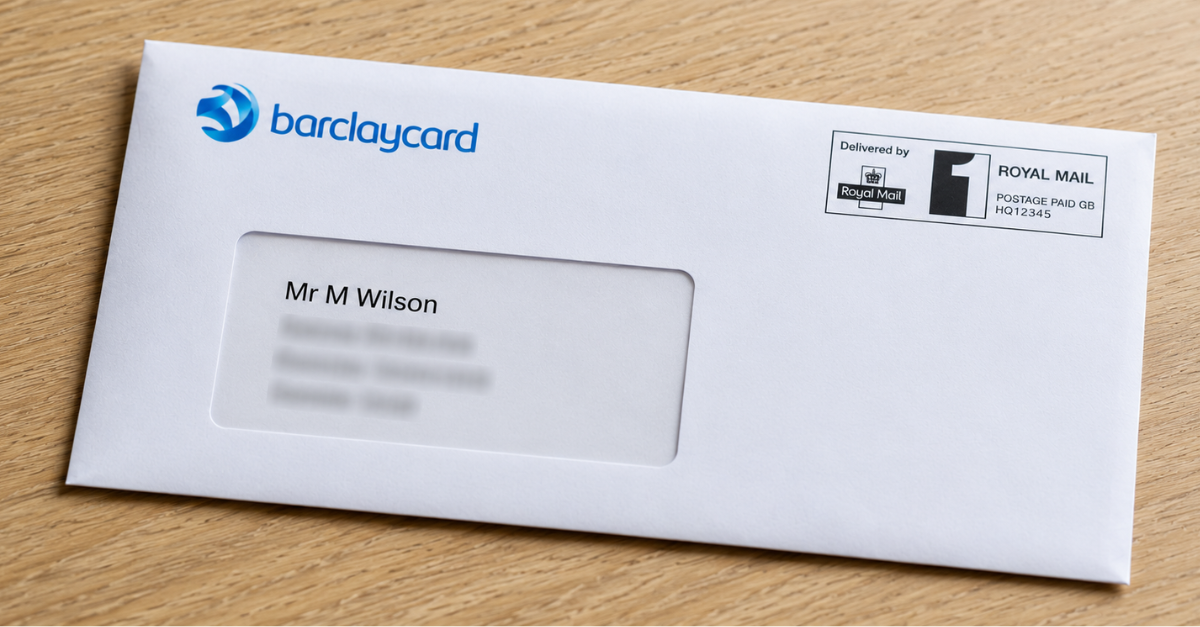
Which Mr M Wilson?
Why is Barclaycard sending me a PIN for a credit card I don’t recognise?
That was the slightly alarming question I found myself asking recently.
The envelope was addressed to “Mr M Wilson” at my home address. That’s me, so I opened it. Inside was correspondence about a PIN for a credit card. I do have a Barclaycard, but I don’t often use it.
After attempting to use this information to change the PIN on my card, and then spending rather more time than I would have liked navigating Barclaycard’s automated telephone system, I eventually worked out what had happened.
The letter wasn’t for me at all. It was for my son.
Similar, but not identical, names
I’m Mark. And one of my adult sons, Matthew, lives at the same address. So we’re both Mr M Wilson.
We both have middle names too, so even using our full initials would distinguish between us.
Yet Barclaycard, along with several other organisations, insists on addressing correspondence using only our title, first initial and surname. Often, inside the envelope, they write something like “Dear Mark” — although not in this case.
Most of the time, that’s just an irritation. One of us opens a letter, starts reading and realises that it belongs to the other. This time, seeing something financial that I didn’t recognise was enough to make me wonder whether there was a problem with an account in my name.
All because the envelope didn’t contain enough information to tell two people at the same address apart.
Why just an initial?
Perhaps it’s about privacy. An initial reveals less than a full first name, so at first glance that might seem consistent with the principle of data minimisation.
But data minimisation doesn’t simply mean using as little information as possible.
The Information Commissioner’s Office says personal data should be “adequate, relevant and limited to what is necessary”. It describes adequate as having enough information to properly fulfil the intended purpose.
The ICO’s guidance on identifiers also notes that, where a name isn’t enough to distinguish between two people, further details may be needed.
The purpose of putting a name on an envelope is surely to identify the intended recipient. At our address, Mr M Wilson doesn’t do that.
And Barclaycard has the information it needs. Emails address me as “Hello Mark”. Somewhere between my customer record and the envelope, Mark becomes M.
Printing “Mark” or “Matthew” instead of “M” would reveal a few additional letters about us to somebody looking at our mail. But not printing them resulted in me opening correspondence about my son’s credit card.
If privacy is the reason for using an initial, that seems a curious outcome.
I tried to ask
Rather than speculate about why Barclaycard addresses its correspondence this way, I thought I’d ask.
After my earlier experience with the telephone system, I tried the messaging service in the Barclaycard app.
Unfortunately, having invited me to “Send us a message”, the app told me that messaging was unavailable and suggested I call instead. You couldn’t make it up…
So I still don’t know why Barclaycard uses only an initial. And, to be fair, it’s not the only organisation that does.
There’s nothing particularly unusual about two adults with the same surname and first initial living at the same address. Nor am I suggesting that putting Mr M Wilson on an envelope is a breach of data protection law.
Most of the time, the only consequence is that one of us opens the other’s post. Occasionally, though, it’s a worrying time wondering why you have been issued a PIN for a credit card you don’t recognise.
I’d happily trade a few more letters on the outside of the envelope to avoid finding out what’s on the inside of someone else’s.