I missed the first day of DTX+UCX London this year, but managed to carve out some time to attend the second.
Unsurprisingly, AI was everywhere. Agents, models, copilots and AI-powered features in seemingly every contact centre, networking and cybersecurity management platform. I’m not suggesting these developments aren’t important, but after a while the messages start to sound remarkably similar.
Fortunately, there were some sessions that explored rather more interesting questions. Not so much what AI can do, but how we adopt it, what it means for people, and whether we’re making sensible decisions about the technology we depend on.
Here are some of my highlights from the day.
Preparing for a TUNA world
Lord Toby Harris, Chair of the National Preparedness Commission, delivered an excellent opening keynote on resilience and recovery. No slides, just a speaker who knew his subject and could hold an audience’s attention.
The National Preparedness Commission was conceived before COVID-19 and has since published around 50 papers examining how the UK can become better prepared for the risks it faces.
Lord Harris described the world we live in as TUNA:
- Turbulent
- Uncertain
- Novel
- Ambiguous
It’s an environment in which preventing disruption isn’t always possible. We also need to think about mitigating the consequences and recovering when things go wrong. He illustrated this with examples of how dependent our everyday lives have become on interconnected infrastructure.
A power failure doesn’t just turn off the lights. It affects telecommunications, transport, water supplies, petrol stations, cash machines and payment systems. Emergency generators might keep essential services running, but only if they’ve been maintained, tested and have sufficient fuel. And even if a hospital has power, can its staff get to work?
The dependencies extend far beyond electricity. Water needs pumping, energy infrastructure needs cooling, food distribution relies on transport, and transport increasingly relies on digital systems.
These are not independent systems. They’re part of a complex web of dependencies, where a failure in one place can have consequences elsewhere.
When the threat isn’t directed at you
An organisation doesn’t need to be the intended target of an attack to suffer the consequences. The recent cyber incidents affecting M&S, Co-op and Jaguar Land Rover have demonstrated how disruption can spread through supply chains. Geopolitical instability creates further risks, particularly where organisations depend on imported materials, components and services.
Lord Harris also raised questions about sovereign capability. How much control do we really have over the infrastructure and services on which our economy depends? That question became particularly relevant during the Q&A, when the discussion turned to AI.
We’re already seeing opposition to data centre developments because of their electricity and water requirements. Meanwhile, we’re increasingly dependent on technology developed and controlled by organisations outside the UK. There’s a balance to be struck between accessing the best available technology and retaining sufficient control over critical national capabilities.
This is a question I’ve been exploring in my own presentations on sovereign AI. Sovereignty isn’t simply about where data is stored or processed. It’s about understanding who controls the technology, what dependencies exist, and what options remain if those relationships change.
Preparing for failure
For organisations, Lord Harris’ advice was to identify their “crown jewels”: the systems, information and capabilities they absolutely depend on.
Then ask what happens when those things aren’t available.
What if your systems are functioning but your suppliers aren’t? What if your employees can’t travel? What if the telecommunications network is unavailable? It’s not enough to have a disaster recovery plan that assumes everything else is working.
Resilience also requires a whole-society approach. Government, businesses, communities and individuals all have responsibilities.
Lord Harris closed with Baden-Powell’s Scout motto from 1908: Be Prepared.
That seems as relevant today as it was in the early 20th Century.
Building AI confidence by giving people permission to play
Julie Creffield, from Oxford Innovation Space, took a very different approach to AI adoption.
She started by asking who in the audience felt completely on top of AI. It’s rather like asking whether people fully understood the Internet in the 1990s. We’re still learning what this technology can do and how it will change our lives. Her central message was that building confidence starts with giving people permission to play.
That might sound obvious, but organisations often approach AI adoption through formal training programmes, policies and productivity targets. We tell people they need to use AI, without necessarily giving them the time or freedom to experiment.
Julie challenged the language we use to describe technology adoption, particularly the familiar labels of early adopters and laggards. Instead, she suggested thinking about people as sceptics, experimenters, integrators, experts and architects. These descriptions are less judgemental and recognise that people approach new technology from different starting points.
Finding opportunities in everyday work
One of the most practical ideas from Julie’s session was her approach to identifying AI use cases through three categories:
- Icks: The tasks you dislike, find draining or spend too much time doing. Repetitive administration, managing email, searching for information and preparing reports.
- Slicks: The things you’re good at and want to spend more time doing. Creative thinking, problem-solving, building relationships and strategic planning.
- Triggers: Recurring situations that create work, pressure or disruption. A new project, an approaching deadline, an unexpected request or a change in priorities.
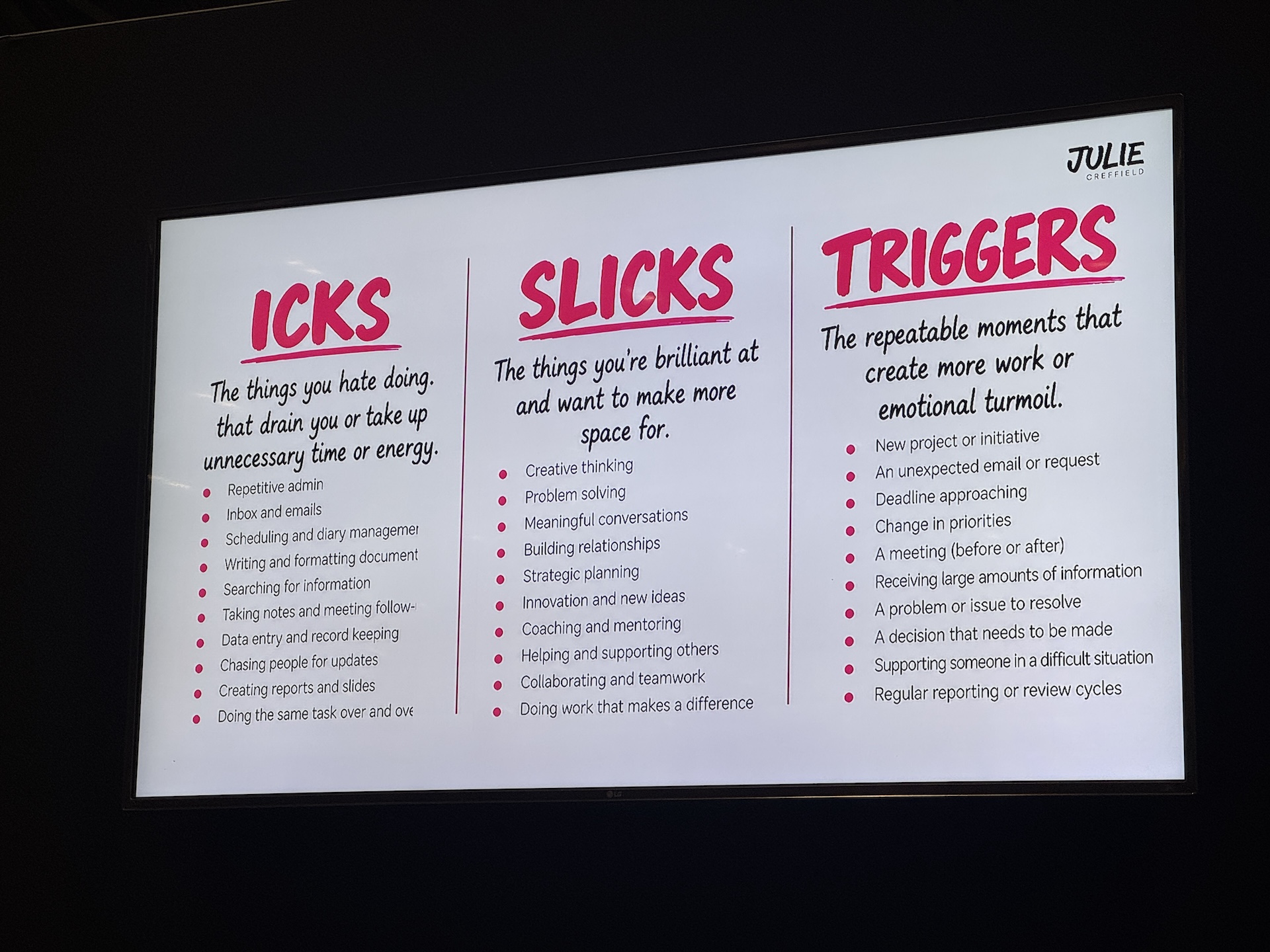
The idea is to use AI to reduce the effort spent on the “icks”, create more space for the “slicks”, and help manage the “triggers”.
It’s a useful way to approach AI adoption without starting with the technology itself.
Julie also shared a simple prompting framework called THINK:
- Task: What am I trying to achieve?
- Human: Who is the AI helping, and what role should it play?
- Instructions: How should it behave and respond?
- kNowledge: What information and context does it need?
- Keep improving: How will I test and refine the results?
The slightly unconventional use of N for Knowledge was deliberate: a reminder that AI can invent information when it doesn’t know the answer.
There’s nothing especially complicated about any of this. That’s rather the point. Building confidence doesn’t necessarily require a sophisticated technical understanding of AI. It requires opportunities to experiment, learn and improve.
Successful change is about people, not technology
Viola de Girolami’s session, The Anatomy of Successful Change, explored why some organisations manage transformation successfully while others struggle.
She structured her presentation around four characteristics: clarity, empathy, a learning mindset and momentum.
Clarity: knowing which mountain you’re climbing
Viola used McDonald’s response to changing customer expectations as an example of an organisation recognising that it needed to evolve.
The important question wasn’t simply what products or services it should introduce, but what kind of organisation it needed to become to remain relevant. The same principle applies to AI.
Viola described AI as a good pair of walking boots. They might help you climb the mountain, but you still need to know which mountain you’re trying to climb.
Too many organisations seem to be starting with the technology and then searching for a problem to solve. Without clarity about the intended outcome, it’s difficult to know whether an investment has been successful.
Empathy: understanding what people fear losing
Another point was that we’re not leading digital transformations. We’re leading human transitions.
People don’t necessarily resist change itself. They resist what they fear losing. That might be familiarity, status, confidence, a sense of belonging or the value they believe they bring to their organisation.
It’s easy to overlook these concerns when discussing transformation in terms of technology platforms, operating models and efficiency targets. But successful change requires us to understand how people experience it, not simply explain why it’s necessary.
Learning: challenging comfortable assumptions
Viola compared our assumptions to a favourite old jumper. It might be worn out, but it’s familiar and comfortable. Organisations develop similar attachments to established ways of thinking.
We need to distinguish between what we know, what we believe and what we’ve simply assumed to be true. That’s particularly important when technology and customer expectations are changing quickly.
Momentum: responding to changing conditions
Finally, Viola talked about the importance of recognising signals from the outside world and adapting accordingly. A strategy shouldn’t become something we follow regardless of changing circumstances.
Her question was a useful one:
“If you were starting today, would your strategy look the same?”
It’s worth asking periodically, particularly when AI is changing both what’s possible and what customers expect.
Nobody gets fired for accepting the defaults
Dan Jones, from Hamina, provided a welcome change of subject with a session about Wi-Fi configuration.
His title referenced the old saying that nobody ever got fired for buying IBM, or Cisco in the networking world. His variation was that nobody gets fired for accepting the defaults. (Except that’s exactly what we’ve spent years telling people not to do in cybersecurity!)
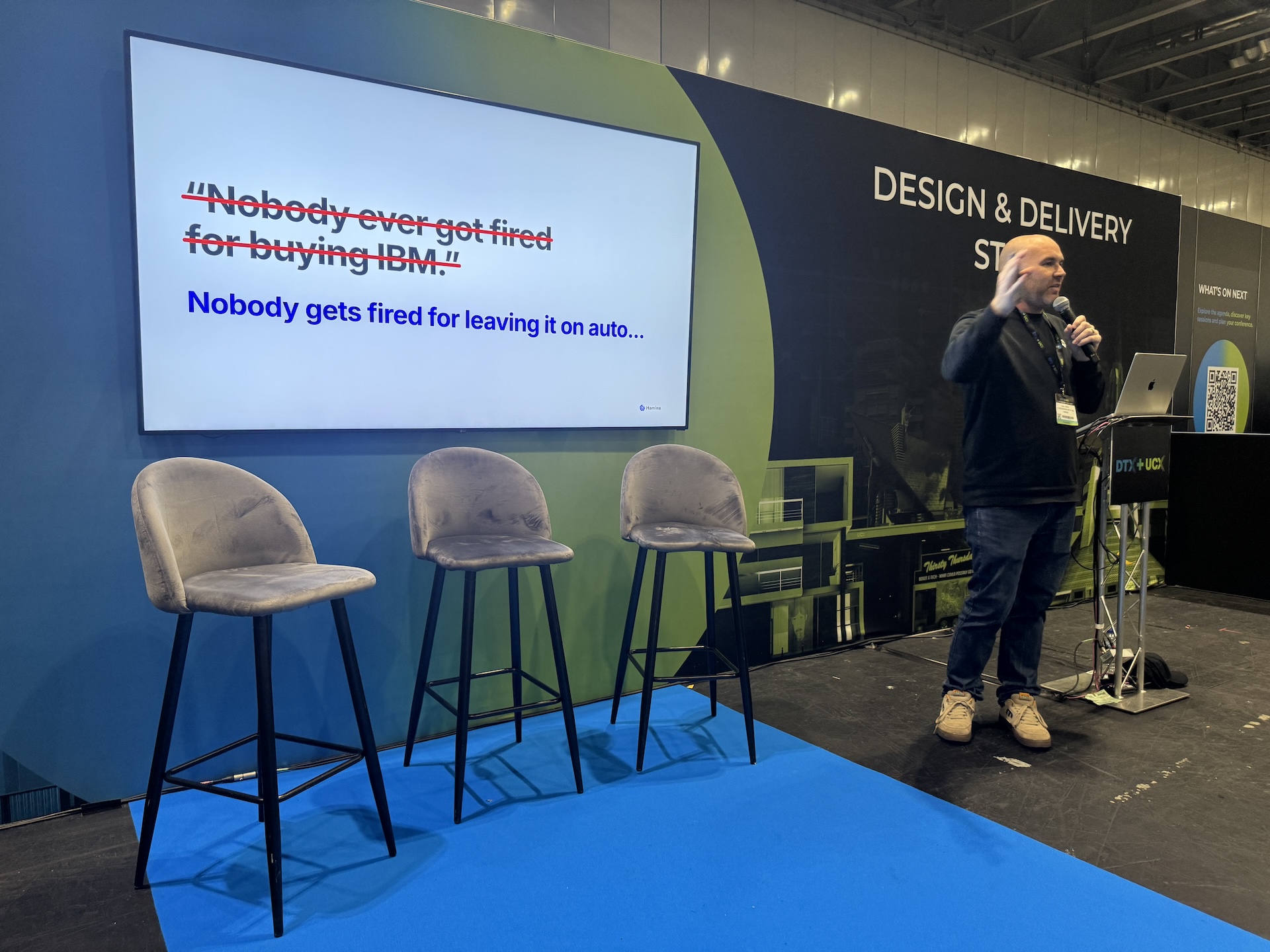
Dan’s argument was that default configurations are typically designed to provide a good initial experience. They aren’t necessarily optimised for the environment in which a system will operate.
He used the example of an office with 28 wireless access points, configured automatically with 80MHz channels. Everything looked fine in the management console, yet users experienced intermittent performance problems. The problem wasn’t necessarily faulty equipment or a broken configuration. It was that the settings weren’t appropriate for the radio environment. Reducing channel widths to 40MHz improved reliability, even though the theoretical maximum speed was lower.
Dan also highlighted that the environment changes. Neighbouring networks, devices and interference can all affect wireless performance. A decision made when an access point starts up may no longer be appropriate later.
The wider lesson wasn’t really about Wi-Fi.
“A default is a decision somebody else made, for somebody else’s requirements.”
We should be able to explain why a system is configured in a particular way, rather than accepting the defaults without question. That applies to performance, reliability and security alike.
Making sense of the EU AI Act
Kevin Lavin from Citi and Jamal Ahmed from Lumi discussed the EU AI Act, drawing on Jamal’s book, “The Easy Peasy Guide to the EU AI Act”, which aims to make the legislation accessible to people without a legal background.
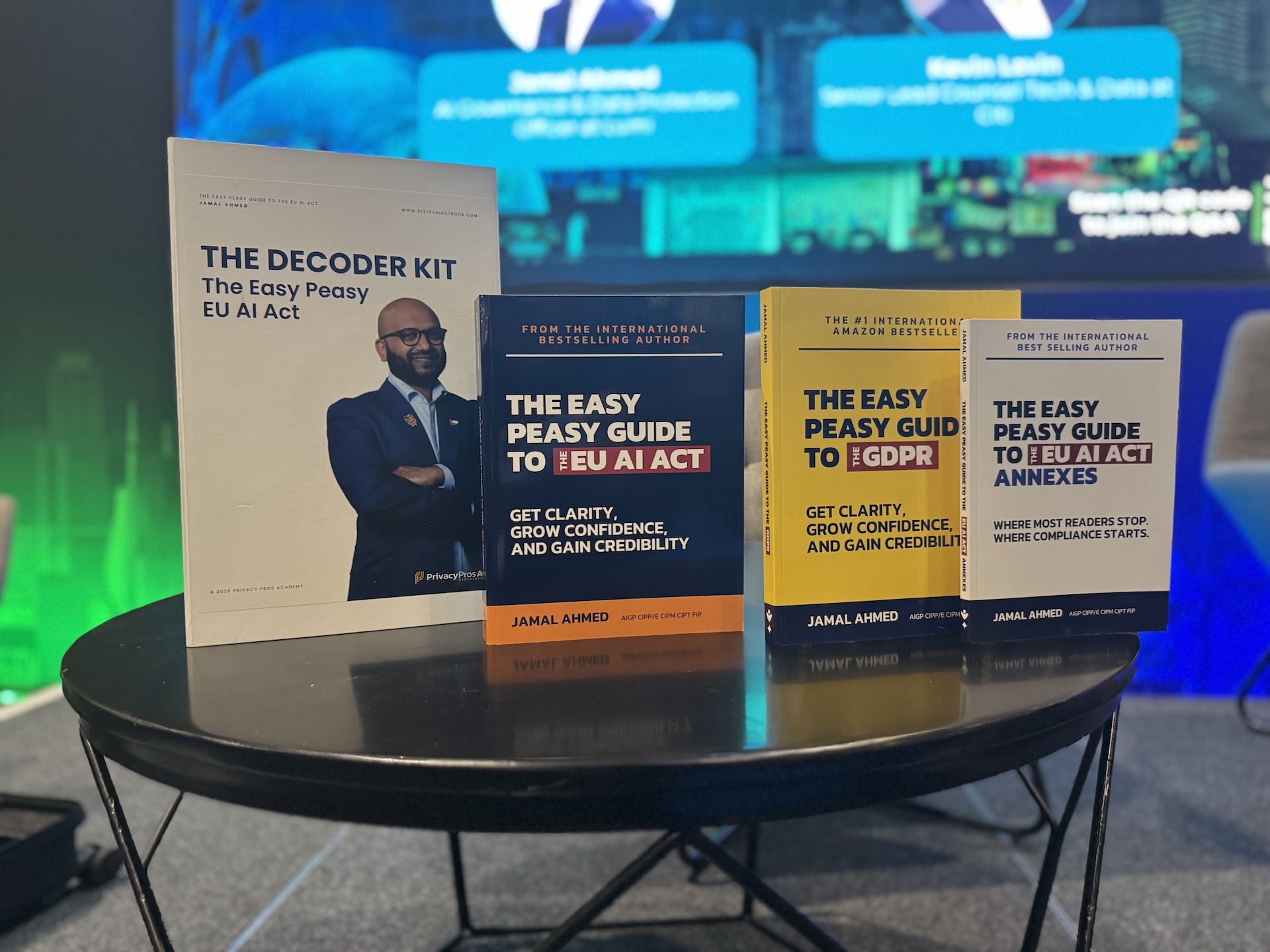
Much of the commentary on AI regulation is written by lawyers for lawyers. The challenge is to simplify complex requirements without losing the important detail.
For UK organisations, there’s also a common misconception that European regulation no longer matters following Brexit. However, the EU AI Act has extraterritorial reach. Depending on how an organisation develops, supplies or uses AI systems, it may have obligations even if it isn’t established in the EU.
The legislation takes a risk-based approach, with different requirements depending on the potential impact of an AI system. Some uses are prohibited. Others, particularly those that could affect people’s safety or fundamental rights, face more extensive obligations. There are also transparency requirements for certain systems and relatively limited obligations for minimal-risk applications.
Importantly, responsibilities don’t fall solely on the organisations developing AI systems. Businesses deploying them may also have obligations.
You can’t govern what you don’t know about
Perhaps the most practical point was the importance of understanding what AI is already being used across an organisation. Shadow AI makes this difficult. Employees may be using AI services to help with everyday tasks without their employer knowing which tools are involved or what information is being shared.
Simply banning AI isn’t necessarily the answer. It can encourage people to find alternative ways to access the tools they believe they need. Instead, organisations need visibility, clear accountability and an understanding of the risks associated with individual use cases.
The discussion also touched on agentic AI, where systems can take actions rather than simply generate responses. This introduces further questions about identity, permissions, accountability and control.
AI governance can’t be treated as a one-off IT compliance exercise. The technology, its uses and the associated risks continue to evolve.
Are we developing the workforce we’ll need tomorrow?
One of the most interesting discussions for me came from the panel on the future workforce, featuring Steven Fuller, Claire Lebarz, Sunita Nicholas and Phil Benson.
The discussion explored how AI is changing work, the skills organisations need and the consequences for career development.
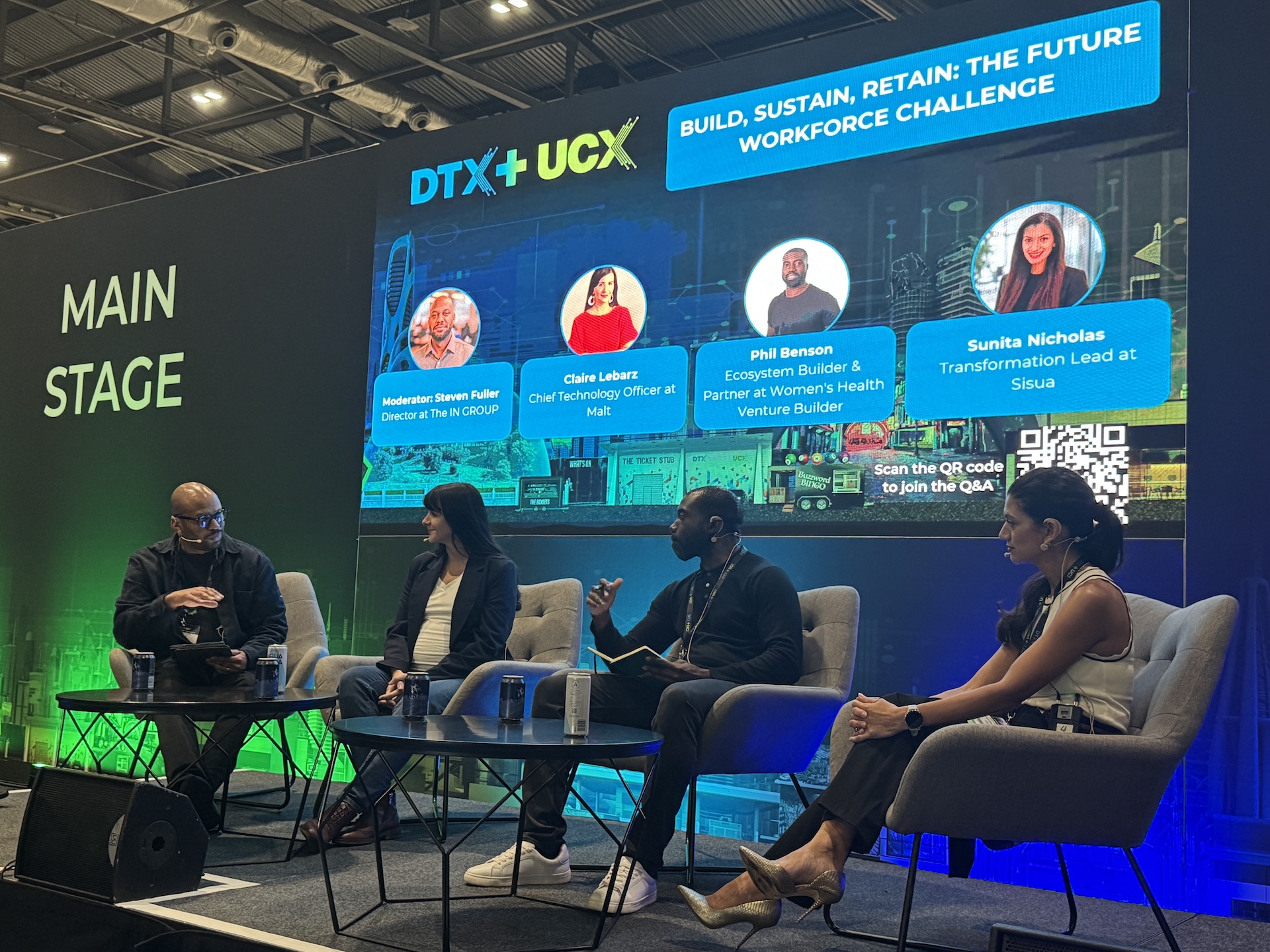
Claire suggested that AI adoption is perhaps 20% a technology challenge and 80% a people and organisational challenge. The exact percentages matter less than the underlying point. Technology is only one part of the equation.
What happens when we automate the learning opportunities?
A particularly interesting concern for me (as a parent of two sons in their 20s) was the effect of AI on junior roles.
Many experienced professionals developed their judgement by doing relatively routine work early in their careers. They made mistakes, learned from colleagues and gradually developed an understanding of context and consequences.
If AI now performs much of that work, how will the next generation gain equivalent experience?
Phil made the point that AI hasn’t necessarily removed the junior job. In some cases, it has effectively promoted people without giving them the training and experience that would traditionally come first. There were different views about whether AI is already reducing entry-level opportunities. Claire suggested that the wider economic environment was a more significant factor than AI itself. But there was broad agreement that organisations need to rethink how people learn.
Productivity isn’t the same as capability
Another theme was the difference between producing more work and developing a more capable workforce. AI can help people complete tasks more quickly, but that doesn’t automatically mean they’re developing the understanding needed to challenge the results. This is particularly important when AI produces something that looks convincing but is incomplete, incorrect or inappropriate.
Domain expertise, critical thinking and professional judgement remain essential.
The panel also discussed mentoring, psychological safety and the importance of giving people opportunities to ask questions and admit mistakes. Remote and distributed working can make some of these things harder, particularly when junior colleagues have fewer opportunities to learn informally from more experienced people.
People are more than their current job descriptions
As AI changes the nature of work, some roles will evolve significantly. That creates challenges for organisations trying to retain experienced employees whose skills and professional identities have developed around particular activities.
Claire argued for a more skills-oriented approach, recognising people’s strengths and helping them move between roles. The discussion also touched on workload, burnout and the pressure to keep adapting. Organisations need to create environments where people can learn and change without feeling that they must constantly work harder to keep up.
Steven closed with a question that captured the discussion well:
“Are we building a workforce that can deliver today, and tomorrow?”
Do we actually need an AI agent?
The final session I attended explored trust in agentic AI, with a panel discussing what happens when agents behave in unexpected ways. The conversation returned to familiar questions about guardrails, permissions and accountability, but there were a couple of points worth retaining.
The first was whether an agent is actually necessary. There’s considerable pressure to adopt agentic AI, but not every problem requires an autonomous system. Sometimes a conventional application, workflow or automation would be more appropriate.
The second was the importance of understanding what an agent is authorised to do. An agent acting within its permissions might still produce an undesirable outcome. That raises questions about whether the problem lies with the agent, its instructions or the permissions it was given.
As with any other technology, security needs to be considered from the outset rather than added afterwards. Human accountability doesn’t disappear simply because software is making decisions or taking actions on our behalf.
Beyond the technology
Looking back over the day, I found the sessions that moved beyond AI features and product capabilities the most useful.
Perhaps that’s because, after several years of increasingly ambitious AI announcements, I’m less interested in hearing what the technology might be capable of and more interested in understanding how organisations are actually going to make it work.
How do we build confidence without losing control? How do we introduce new capabilities without creating dependencies we don’t understand? And how do we improve productivity without undermining the development of the people we’ll need in future?
I don’t expect a technology conference to answer all those questions. But I’m glad that some of the speakers were asking them.