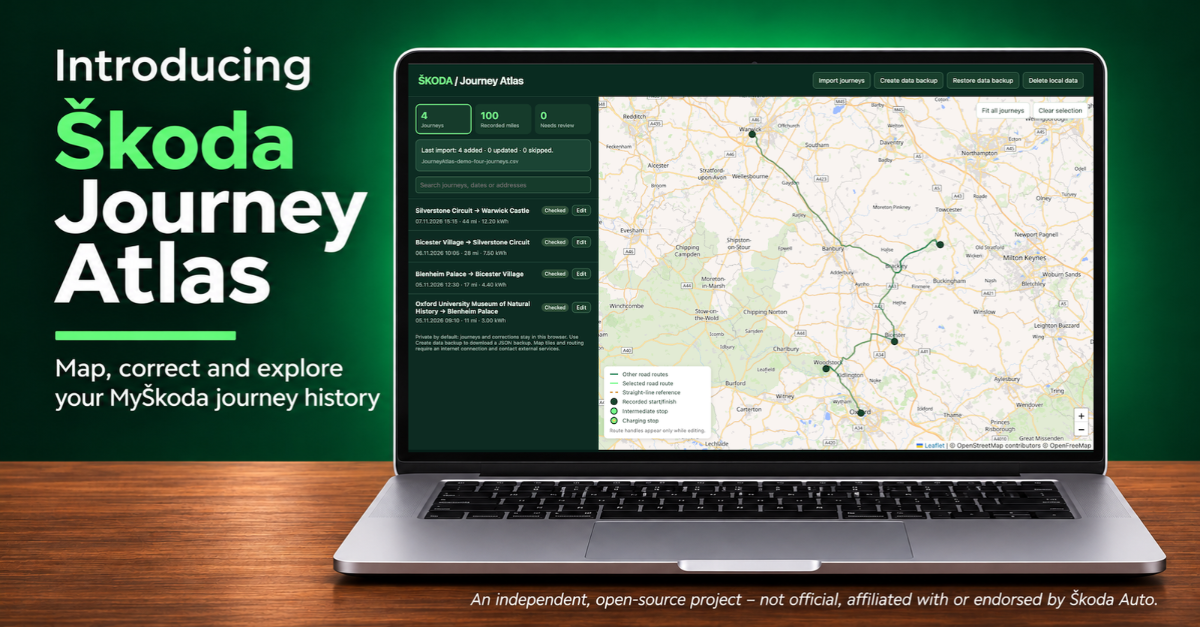
I’d only had my new car for a few days when I found myself building software to work around one of its shortcomings. Not the car itself, which I’m enjoying driving, but the journey history recorded by the MyŠkoda app.
The MyŠkoda connected car app records useful statistics about each journey, including distance, duration and energy consumption. It also displays each journey on its own small map, with intermediate points where the car has stopped. Unfortunately, the data can be rather sketchy. In the first few days I’ve encountered incomplete location information, missing journeys and inconsistencies between what the app displays and what it exports to CSV. In particular, intermediate stops visible in the app aren’t included in the export. Some journeys only appear after MyŠkoda has processed them overnight, so what initially looks like missing data may simply be delayed. And sometimes, getting a complete and reliable export from MyŠkoda is less straightforward than it should be.
I wanted to see all my journeys together, correct incomplete records and build up a history that I could keep. And, while MyŠkoda knows where a journey started and finished, that isn’t necessarily enough to work out which roads I travelled.
Introducing Škoda Journey Atlas
The result is Škoda Journey Atlas, a free, open-source companion to MyŠkoda.
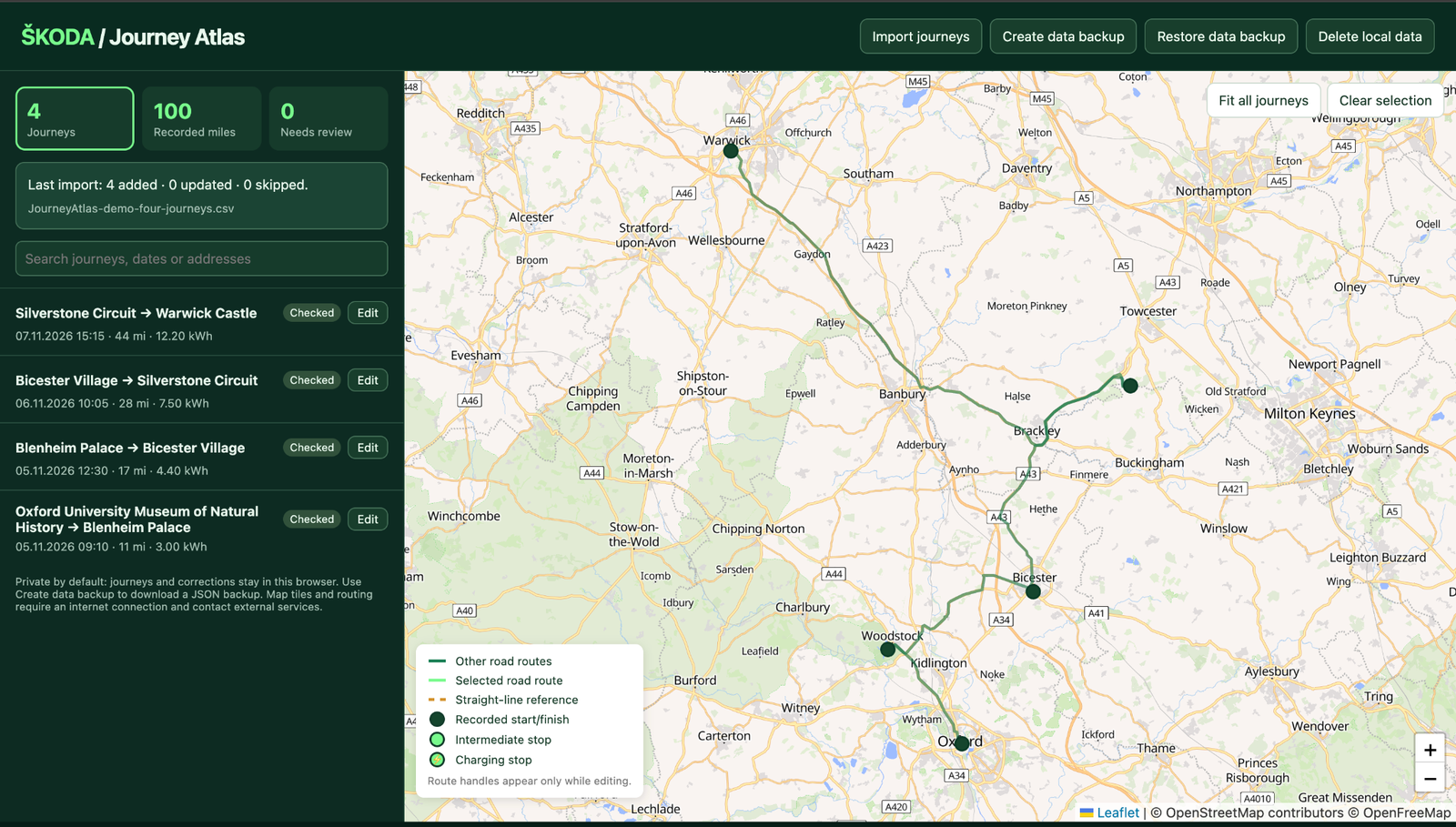
Journey Atlas imports journey statistics from MyŠkoda’s CSV exports and displays them on an interactive map. It can estimate road routes between recorded locations, which can be refined by adding shaping points, intermediate stops, charging stops and turnarounds. It can also correct locations and times, add notes, mark journeys for review and compare the distance recorded by MyŠkoda with the estimated road distance.
The distinction between recorded and estimated information matters. Journey Atlas doesn’t recover a GPS track that MyŠkoda hasn’t exported. It reconstructs a plausible route using the information available, supplemented by points added manually.
For mapping, it uses OpenFreeMap, which provides maps based on OpenStreetMap data, rendered using MapLibre GL JS and Leaflet. Road routing is handled by OSRM. It’s a useful combination of open-source technologies that avoids the need for commercial mapping API keys.
Keeping things simple
I wanted something lightweight rather than another online service. Journey Atlas is written in HTML, CSS and JavaScript, with no server, database or installation process. Download the files, open index.html in a browser and import a CSV export from MyŠkoda.
Journeys and corrections are stored locally in the browser, with JSON backup and restore functionality to preserve the data or move it elsewhere. Subsequent CSV imports are checked for duplicates and possible revisions, so it’s possible to build up a history without repeatedly importing the same records. Map tiles and routing still use external services, but there’s no central Journey Atlas database holding anyone’s travel history.
I developed the application with assistance from ChatGPT, which made it possible to quickly move from an idea to working software. That didn’t mean everything worked first time. We spent considerable time refining the import process, route editing, map controls and handling of incomplete records. As with any AI-assisted development, understanding the problem, making design decisions and testing the results remained essential.
A public beta
I’ve published v1.0.0-beta.1 on GitHub under the MIT licence, along with a user guide and a backlog of possible enhancements. I’m particularly interested in adding energy-efficiency analysis, using the journey statistics to explore trends in consumption over time.
For now, though, I’d like to see how it works for other Škoda owners. I’ve developed and tested Journey Atlas using my 2026 Enyaq, running vehicle software 6.0.1, and MyŠkoda for iOS v8.18.0. Other vehicles and app versions may produce different exports, so feedback and bug reports are welcome through GitHub Issues. Just be careful not to share personal journey data in public reports.
Journey Atlas won’t fix the underlying problems with MyŠkoda’s data, but it does give me a way to make better use of what the app records, correct what I know is wrong and preserve a more useful history of my travels. What started as a minor frustration with a new car has turned into an open-source project that I hope others will find useful too.
Although Journey Atlas currently supports MyŠkoda exports, there’s no reason the underlying approach couldn’t work with connected car apps from other manufacturers. Indeed, I had intended to do something similar with the data from the Volvo I previously drove. The main challenge would be adapting the import process to their data formats. For now, I’m concentrating on making the Škoda experience work well, but broader compatibility could be an interesting direction for the future.